

She Ran 20 Marathons — But Couldn’t Outrun a Heart Attack
February 12, 2026
Former Trenton patient Christine Ankenbauer has participated in 20-plus marathons and has developed an endurance to push through discomfort.
But the morning she woke up struggling to breathe, she realized this was something she couldn’t push through — a heart attack.
“I felt like there was a sign, ‘you have to get help,’” she said.
Christine arrived at the Trenton emergency department early last year for substernal chest pain after running seven miles the previous night. Her symptoms also included swelling, chest pressure, and feeling like she was, “Being stabbed with a bunch of knives.”
She called EMS and paramedics identified a ST-segment elevation myocardial infarction, or STEMI, just eight minutes prior to her arrival. With the advanced notice, the cath lab was activated before she even arrived, shaving off 10 precious minutes before treatment began.
Providers discovered that Christine’s entire right coronary artery was completely blocked. Without immediate treatment, she would’ve died.
The teams of clinical nurse managers Chas Arnold, emergency center, and Katie Sturgill, cath lab/interventional radiology, were ready to save Christine’s life.
Chas and Katie said Christine’s case is an example of what happens when everything goes right. Their teams work closely together and they’re always looking at ways to make the process even easier, better, and faster for patients.
“Our patients get overwhelmed in those situations, but we tell them we're like a pit crew,” Katie said. “We all have our job. We know what we need to do, and the clock is always ticking in our heads.”
Meeting the team
Many amazing team members contributed to Christine’s care, including emergency medicine physician Susan Horling, DO, and interventional cardiologist Michael Ashbrook, MD.
On Katie’s team, Jessica Storms, radiology technologist, was Dr. Ashbrook's right hand, handing him wires and catheters as he worked on Christine. Michelle Fore-Haines, radiology technologist, monitored the hemodynamics, rhythm, and pressure.
Later in recovery, the Trenton cardiac rehab team helped get Christine back on the running path with their safe monitoring and, “Wiped away a lot of tears for me too,” she said.
There were many more team members who Christine listed in a thank you letter she sent to patient relations following her care, and she had the opportunity to thank some of them in person when she visited the hospital in July 2025.
It was hard to return to a place where she had such hard memories, but it was worth it to thank the team. Christine also works in health care and knows how special it is to have someone return to share how the team has positively impacted their life.
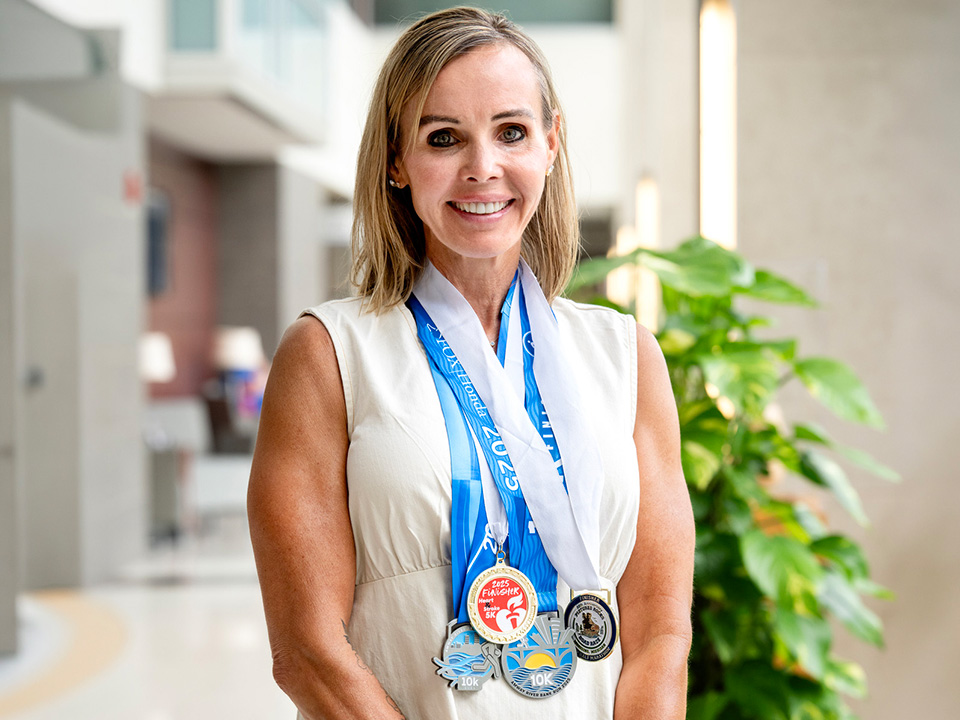
She was able to show the team how far she’s come in her recovery and that in the five months since they saved her life, she’d run five races — complete with the medals she received for her efforts.
Chas said it was rare and truly special to have someone return to the emergency department to say thank you.
“We know we save hundreds, but to see somebody walk back through, it's gratifying,” he said. “In the back of your head, you're like, ‘There it is. That's the reason why we do it.’ It puts a face to it.”
“It's definitely nice for my crew to be able to get a thank you,” Katie told Christine. “To be able to see someone afterward down the road and see your medals and hear that you're running, that does our hearts good.”
Helping others recognize the signs
Chas said the “craziest” part about Christine’s case is that she’d run seven miles the day before her heart attack.
"The fact that you came in, somebody completely healthy, is a shock,” he said.
Christine said she was embarrassed she had a heart attack because she felt like she did everything right. She exercised and ate healthy. Her coworkers even sent her a fruit basket while she was in the hospital because they knew she wouldn’t eat sweets.
“And you know that some people will say, ‘Well, why do all that? Because you had a heart attack anyhow,’ but I could’ve died or had a stroke or had more vessels occluded. I mean, it could’ve been so much worse,” she said.
She said she feels there must be a reason she had a heart attack and survived. By visiting the team and sharing her story, she hopes to help other women learn about heart health.
“I’m so grateful I was given the opportunity to personally thank these amazing people and to bring our communities awareness,” she said. “Unfortunately, no one is immune to this kind of event and it’s really important to take care of ourselves. It’s also just as important to realize that typically when something doesn’t feel ‘right’ you’re probably right!”