

Eight Gallons Donated and Still Going
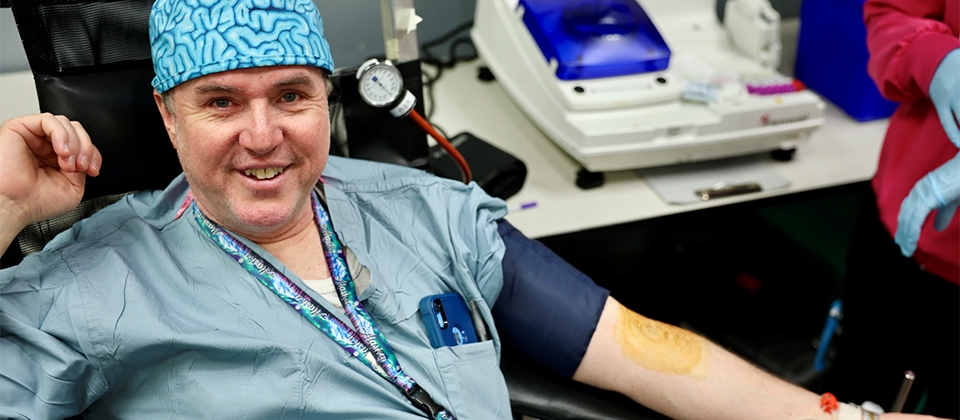
In his role as a neuropathologist at Corewell Health William Beaumont University Hospital, Joseph Fullmer, MD, gets to see firsthand how donating blood is essential in helping patients survive surgeries, cancer treatment, chronic illnesses, and traumatic injuries. He also practices general anatomic pathology.
A neuropathologist is a specialist in the diagnosis and study of diseases of the nervous system, including the brain, spinal cord, peripheral nerves, and muscles.
They examine tissue samples microscopically as well as perform molecular analyses (i.e., determining if a tumor has a certain protein that may allow it to be treated with a certain drug, which can lead to personalized medicine), to identify abnormalities and diagnose conditions like tumors, neurodegenerative diseases, and other neurological disorders. Dr. Fullmer also does similar analysis on systemic body tumors outside the nervous system.
“I liked the brain ever since I was a child and knew I wanted to be a doctor,” said Dr. Fullmer.
“There are two main branches of pathology," said Dr. Fullmer. "One’s anatomical pathology, where we look at tissues, and then there’s clinical pathology, which deals with lab test results. One area of my department is the blood bank, so we’re aware of the issues with blood transfusion and the need to donate blood.”
So far, Dr. Fullmer has donated close to eight gallons of blood, and that’s just what he has donated here at Corewell Health. He has donated more than that elsewhere. The choice to donate started with his father being a donor.
“My dad used to do it, so I thought I can help by donating too. I did it because it was the right thing to do, to help out, knowing people have blood transfusions," said Dr. Fullmer. "There’s a dire need to donate blood, especially O+ and O-. As a physician, we can’t do operations without blood. I know people who need a lot of blood transfusions, where they require 20 units or more.”
Despite his busy schedule as a physician, Dr. Fullmer always tries to make time to help donate blood. He’s even encouraged his family to donate as well.
“My kids like the snacks they get,” Dr. Fullmer said with a laugh. “My two sons find it very easy. It’s a great thing to see how you yourself, being a donor, can catch on with others after they know you donate, seeing how easy it is and the benefits it provides. And after, to then see them become regular donors themselves.”
You can find a complete list of dates, times, and locations to give blood at one of the community blood drives here.
The donation process usually takes one hour, including registration, a brief medical screening, and blood collection. Donors must show a photo ID, such as a driver’s license.
For more information on blood donation, or to schedule an appointment, visit donate.michigan.versiti.org.